The European food-service and catering sectors have spent the last few years navigating an unprecedented shift. Between the Single-Use Plastics Directive (SUPD), evolving national packaging laws, and consumers scrutinizing single-use waste at the takeaway counter, hospitality operators face a genuine operational headache: how to eliminate petrochemical plastics without sacrificing heat tolerance, barrier performance, or margin integrity. Among the specialized B2B suppliers addressing this friction in Central Europe, BiologischVerpacken—operating under the broader Green Box brand—stands out as one of the most comprehensive and practical platforms currently on the market.
A Cohesive Product Range Designed for Working Kitchens
Many packaging vendors present an eco-friendly catalog that looks impressive on paper but falters on a busy pass. Paper containers collapse under steam, compostable lids warp over hot broth, and grease bleeds through after twenty minutes in transit. BiologischVerpacken bypasses many of these common pitfalls by focusing strictly on functional material science tailored to high-volume commercial kitchens.
The catalog spans thousands of references covering takeaway containers, burger boxes, soup bowls, cutlery, and bakery supplies. What sets their offering apart is material diversity:
-
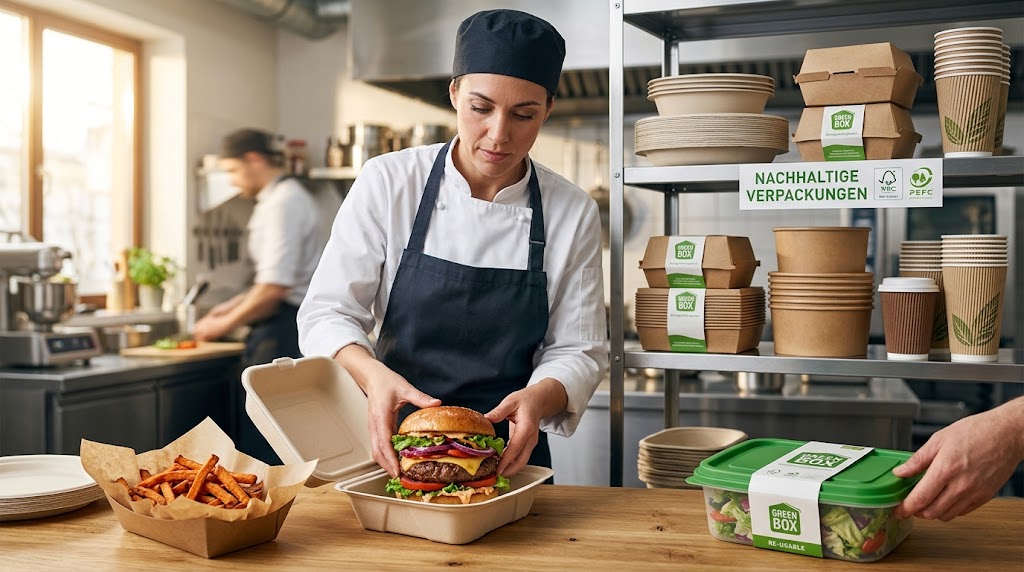
Agricultural byproducts and plant fibers: Unbleached sugarcane bagasse and palm leaf tableware (under their Palmware® line) provide rigidity, natural water resistance, and an unrefined aesthetic that immediately signals sustainability to guests.
-
Bio-based barrier alternatives: For cold drinks and deli displays, their PLA and rPET options deliver optical clarity while maintaining standard beverage dimensions.
-
FSC® and PEFC-certified fibers: Heavy-duty corrugated cardboard and kraft paper formulations handle grease-heavy foods, such as smash burgers and fries, without relying on traditional polyethylene linings.
Crucially, the items do not feel like conceptual prototypes; they feel engineered for grease retention, thermal stability, and tight stacking in cramped back-of-house storage.
The Hybrid Strategy: Bridging Disposable and Reusable Systems
One of the platform’s smartest operational features is how it addresses the transition between single-use and deposit-friendly reusable formats (Mehrweg). Many operators hesitate to buy into returnable containers because they disrupt existing menu portions or require completely separate lid inventories.
BiologischVerpacken solves this by designing several of its reusable lines (such as their proprietary Häppy bio-compound series) as direct dimensional mirrors of their disposable counterparts. A restaurant using their disposable kraft bowl can transition to the reusable model without recalculating portion sizes or rearranging kitchen assembly lines. Even more practical, certain reusable bases accept disposable lids from the same series, giving operators modular flexibility during peak shifts or festival services where fully closed-loop deposit returns are impractical.
Logistics, Ordering Economics, and Risk Reduction
For independent cafés, food trucks, and medium-scale caterers, switching packaging suppliers carries cash-flow and storage risks. Committing to a full pallet of untried containers can tie up working capital and back-room space.
BiologischVerpacken accommodates these operational realities in three distinct ways:
-
Free Sample Fulfillment: Operators can request physical product samples directly through the storefront before committing to bulk volume. This eliminates guesswork regarding sauce viscosity, steam buildup, and fit.
-
Tiered Wholesale Quantities: Instead of enforcing rigid pallet-only minimums, the platform allows businesses to order by the sub-pack or single master carton. This flexibility supports seasonal pop-ups and smaller venues that lack warehousing capacity.
-
Predictable European Fulfillment: With dispatch typically occurring within one to three business days and free domestic freight thresholds starting around €200, lead times remain dependable enough for weekly replenishment. Over half of the portfolio is sourced within Europe, helping reduce the vulnerability to shipping disruptions that frequently plagues imported containers.
Beyond off-the-shelf inventory, the site includes a dedicated custom-branding service. Businesses can apply custom artwork and logos across greaseproof wraps, coffee sleeves, paper carrier bags, and reusable containers, helping brands maintain a cohesive corporate identity without orchestrating separate third-party print contracts.
Transparency and Climate Accounting
Greenwashing remains rampant across commercial disposables, with vague “biodegradable” badges frequently masking non-compliant composite materials. BiologischVerpacken approaches this with commendable transparency. Product sheets routinely clarify the exact compostability standards (such as EN 13432), specify raw material origins, and state whether an item is certified for industrial composting, home composting, or standard paper recycling streams.
Furthermore, the company operates under audited quality frameworks (ISO 9001) and actively tracks carbon offsets across its logistics footprint through ClimateSafe360 programs, compensating for dozens of millions of kilograms of carbon to date.
Final Assessment
BiologischVerpacken is not the absolute cheapest packaging distributor operating in Germany, nor does it attempt to compete with rock-bottom clearance wholesalers selling legacy plastic surplus. Instead, it positions itself as a dependable, compliant partner for food businesses that treat packaging as a core touchpoint of their brand and regulatory strategy.
Between the complimentary sample system, cross-compatible reusable containers, and verified raw materials, the platform removes the friction from going sustainable. For any hospitality business, ghost kitchen, or corporate caterer looking to modernize its takeaway workflow without compromising kitchen functionality, BiologischVerpacken warrants serious consideration.
